Piano Lessons
Discover the joy of music with personalized piano lessons for all ages.
Private Lessons
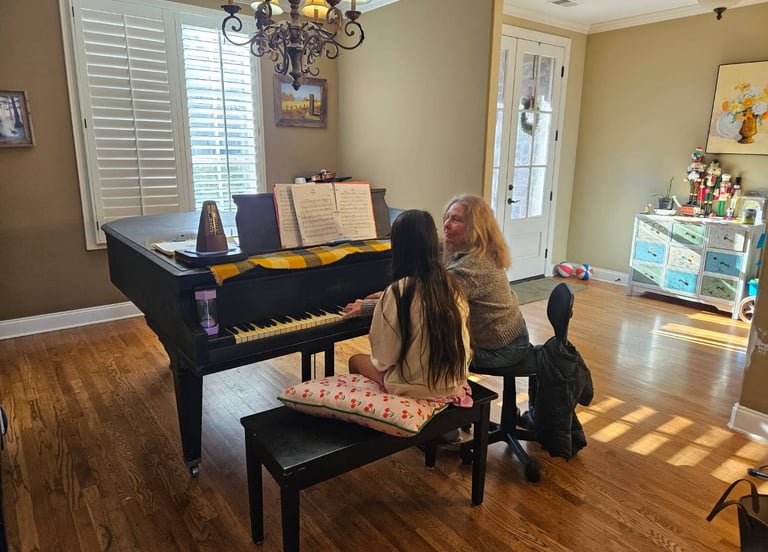
Tailored piano lessons for youth and adults in a supportive environment.
Flexible Scheduling
Choose lesson times that fit your busy lifestyle and commitments.
Experienced Instructor
Learn from a dedicated teacher with years of music education experience.
Suzuki Method Lessons
Students may begin lessons as early as 3 years old.
A parent attends all lessons and is the teacher at home.
Students learn to play in the same way they learned their native language; first listening then repeating.
A firm technique and listening skills develop quickly.
In the beginning, reading the notes is secondary to technique and listening.
The Suzuki Method uses graded books.
Students learn with a lot of repetition, encouragement and love.
Listening to recordings of the graded repertoire is very important.
Traditional Piano
Students begin lessons at 5 or 6 years old, depending on their reading ability.
Reading the music is important from the first lesson.
The repertoire is graded from a variety of publishers matching the student's learning style.

Beginner Group Piano Course
Jan 31, 2026 – April 25, 2026
( 12 Lessons - 1 Week Off in March)
$240 for a 12-week group course
$60 per hour for private lesson
Meeting Location : 4750 Eiffel Ln. Nesbit, MS 38651
Week 1: Piano Orientation & Rhythm Basics
High and low sounds on the piano
Black keys (groups of 2 and 3)
Key names (A–G)
Finger numbers (RH & LH)
Staff: lines and spaces
Rhythms: whole, half, quarter notes
Rests: whole, half, quarter
Steady beat vs rhythm (clapping/counting)
Week 2: Clefs, Landmark Notes & First Reading
Review Week 1
Treble clef and bass clef
Landmark notes: F, C, G
Interval of a 2nd (step)
Middle C position (keyboard and staff)
Play 4 pieces from Music Tree (pp. 4–5)
Introduction to step vs skip
Week 3: Dynamics & Musical Symbols
Dynamics: piano (p), forte (f)
Musical symbols: bar line, double bar, repeat sign
Old MacDonald (black keys and dynamics)
Legato vs staccato (listening and playing)
Week 4: Review & Assessment
Review all rhythm values and rests
Review dynamics and symbols
Flashcard-style note and symbol review (teacher-led)
Review Old MacDonald
Review Music Tree pieces
Short written worksheet (notes/rhythms)
Week 5: Time Signatures & C Position
Time signatures (4/4)
Measures and bar lines
Counting and conducting patterns
Introduction to John Thompson method
C position on keyboard and staff
Playing easy C-position pieces
Review:
Key names
Finger numbers
Basic rhythms
Week 6: Right-Hand Technique
RH technique:
Proper hand shape
Relaxation vs tension
Finger independence
Review Middle C position note names
John Thompson easy pieces (RH focus)
Counting aloud while playing
Week 7: Left-Hand Technique & Coordination
Review RH technique
LH technique:
Hand shape
Finger numbers
Relaxed wrist
Middle C position notes for LH and RH
John Thompson easy hands-together pieces
Week 8: Treble C Position
Review Middle C position (staff and keyboard)
Introduce Treble C position
Locate Treble C notes on staff and keyboard
Directional reading (up, down, repeat notes)
Week 9: Reading Fluency
Review Middle C and Treble C positions
Identify notes on staff and keyboard
Step, skip, repeat patterns
Simple sight-reading exercises
Week 10: Technique Through Repertoire
Suzuki technique:
Twinkle Variations A & B
Repertoire:
Twinkle, Twinkle Little Star
Mary Had a Little Lamb
Tone production and phrasing
Week 11: Expanded Repertoire & Evaluation
Repertoire:
Honey Bee
Lightly Row
Allegretto II
Hands together coordination
Written take-home quiz (notes, rhythms, symbols)
Performance readiness discussion
Week 12: Recital Preparation
Individual coaching on recital pieces
Technique polishing
Performance posture and etiquette
Final review of:
Notes
Rhythms
Symbols